Ask an AI assistant for a good dentist, plumber or coffee shop nearby and it won't hand you a page of links. It names a few businesses and stops. If yours isn't one of them, that customer never sees you.
What the study found
SOCi's 2026 Local Visibility Index analyzed more than 350,000 locations belonging to 2,751 multi-location brands. Researchers asked ChatGPT, Gemini and Perplexity to recommend a type of business in each location's market and counted how often each location made the top five. ChatGPT recommended 1.2% of them, Perplexity 7.4% and Gemini 11%. For the same brands, Google's local 3-Pack, the map results at the top of a search, showed them 35.9% of the time.
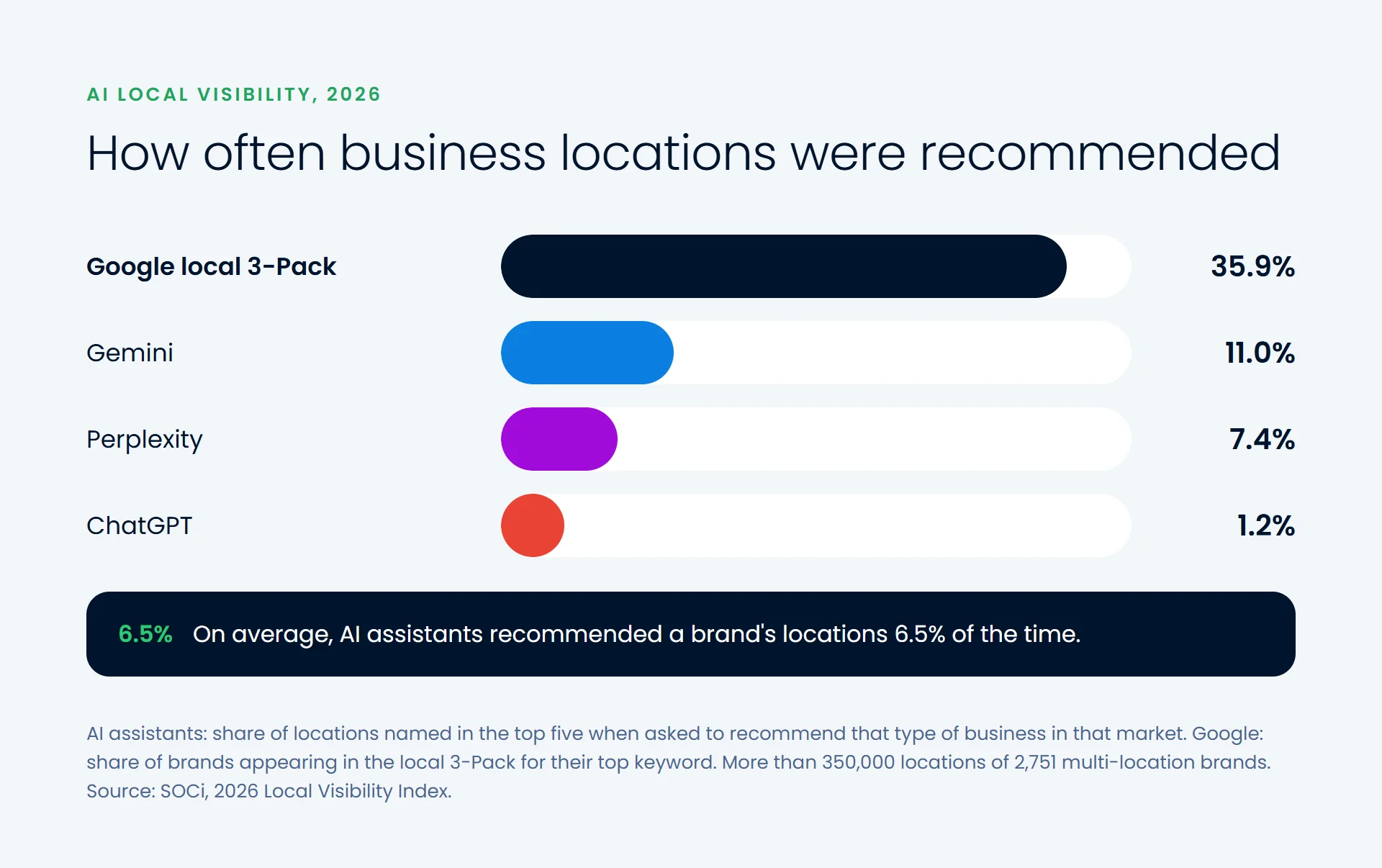
SOCi calls AI visibility nearly 30 times more selective than traditional local search, and doing well on Google doesn't carry over automatically. In retail, only 45% of the brands most visible in local search were also among those AI assistants recommended most. The study covered chains, but SOCi notes that AI systems often favor single-location businesses, whose details and reviews are simpler and more consistent. For an independent business, that's an opening.
Customers are already asking
This would be a curiosity if nobody used AI to find a business. In BrightLocal's Local Consumer Review Survey 2026 of 1,002 US consumers, 45% had used ChatGPT or another AI tool for local recommendations, up from 6% a year earlier. That made AI the third most popular source of recommendations, behind Google and Facebook, and 40% said they trust AI platforms to recommend businesses.
Why most businesses don't make the list
An AI assistant names a business when the evidence about it is strong and consistent across many sources. SOCi found that assistants draw mainly on Google Maps, business websites, Yelp and Facebook, and that locations ChatGPT recommended averaged 4.3 stars. Inconsistent or incomplete listings, such as mismatched hours, duplicate listings and outdated phone numbers, can drop a business from consideration. In Whitespark's Local Search Ranking Factors survey of 47 local search experts, the factors rated most important for AI visibility included appearing on curated "best of" lists, a dedicated page for each service, mentions in news articles and on industry sites, and reviews on trusted third-party sites.
Some businesses lock themselves out. OpenAI says sites that block its OAI-SearchBot crawler won't be shown in ChatGPT search answers. A robots.txt rule written years ago to keep bots away can keep you out of the answer.
Don't chase a ranking
AI answers also change from one request to the next. In SparkToro's research with Gumshoe.ai, 600 volunteers ran the same prompts through ChatGPT, Claude and Google's AI 2,961 times. The chance of getting the same list of brands twice was under 1 in 100, and the same order was rarer still. A tool that reports your "position in ChatGPT" is measuring noise. What holds up is how often you're named across many prompts, which is how both studies measure it.
What to do this quarter
- Fix your listings. Name, address, phone number, hours and categories should match on Google, Apple Maps, Bing, Yelp, Facebook and your website. Remove duplicates.
- Earn recent reviews and reply to them. BrightLocal found that 74% of consumers look for reviews written in the last three months.
- Give every service its own page. Say what you do, where and for whom, in the words customers use when they ask.
- Add structured data. Schema.org LocalBusiness markup states your name, address, hours and services in a form software reads reliably.
- Check your robots.txt. Let search crawlers, including OAI-SearchBot, reach your public pages.
- Measure how often, not where. Ask the same questions every month, many times over, and track how often you're named.
Our website team builds sites with Schema.org structured data and runs performance and SEO checks before and after launch. If you'd like a second opinion on how your site reads to search engines and AI assistants, we can help.