
Ask five firms what your software will cost and you may get five very different numbers. That isn't always padding or guesswork. Each quote rests on different assumptions about what you're buying: how much the first version does, who builds it, where they are, and what happens after launch.
What the averages say
Clutch, which collects verified client reviews of development firms, puts the average reviewed project at about $132,000 over roughly 13 months, while the most common budget falls between $10,000 and $49,999. Most firms listed there charge $25 to $49 an hour, a range shaped by how many of them work from lower-cost regions. For comparison, the US Bureau of Labor Statistics puts the median annual wage for software developers at $135,980 (May 2025), before benefits, tools and management. Averages hide a wide range, which is why the factors matter more than the number.
A simple way to read any quote is effort multiplied by rate. A team of four working for six months spends roughly 4,000 hours. At $25 an hour that's about $100,000; at $150 an hour it's about $600,000. Same effort, six times the price. So when quotes differ, ask first whether they assume different amounts of work, and only then compare rates.
The factors behind the price
- Scope. The number of user roles, screens, workflows and business rules. Every "and it should also" adds design, build and testing time.
- Integrations and data. Connecting to an ERP, CRM, payment provider or older system, and moving existing data across, often takes more effort than the new screens.
- Platforms. A web app, an iOS app and an Android app are three things to design, build and test, unless a shared framework covers them.
- Security and compliance. Handling payments, health or financial data adds access controls, audit trails, testing and documentation.
- Design depth. Research and usability testing cost money up front, and usually save more by avoiding rework later.
- Team and location. Seniority and rates vary widely. A smaller senior team can cost less overall than a larger junior one.
- Speed. A shorter timeline means more people working in parallel, which adds coordination cost.
Why estimates go wrong
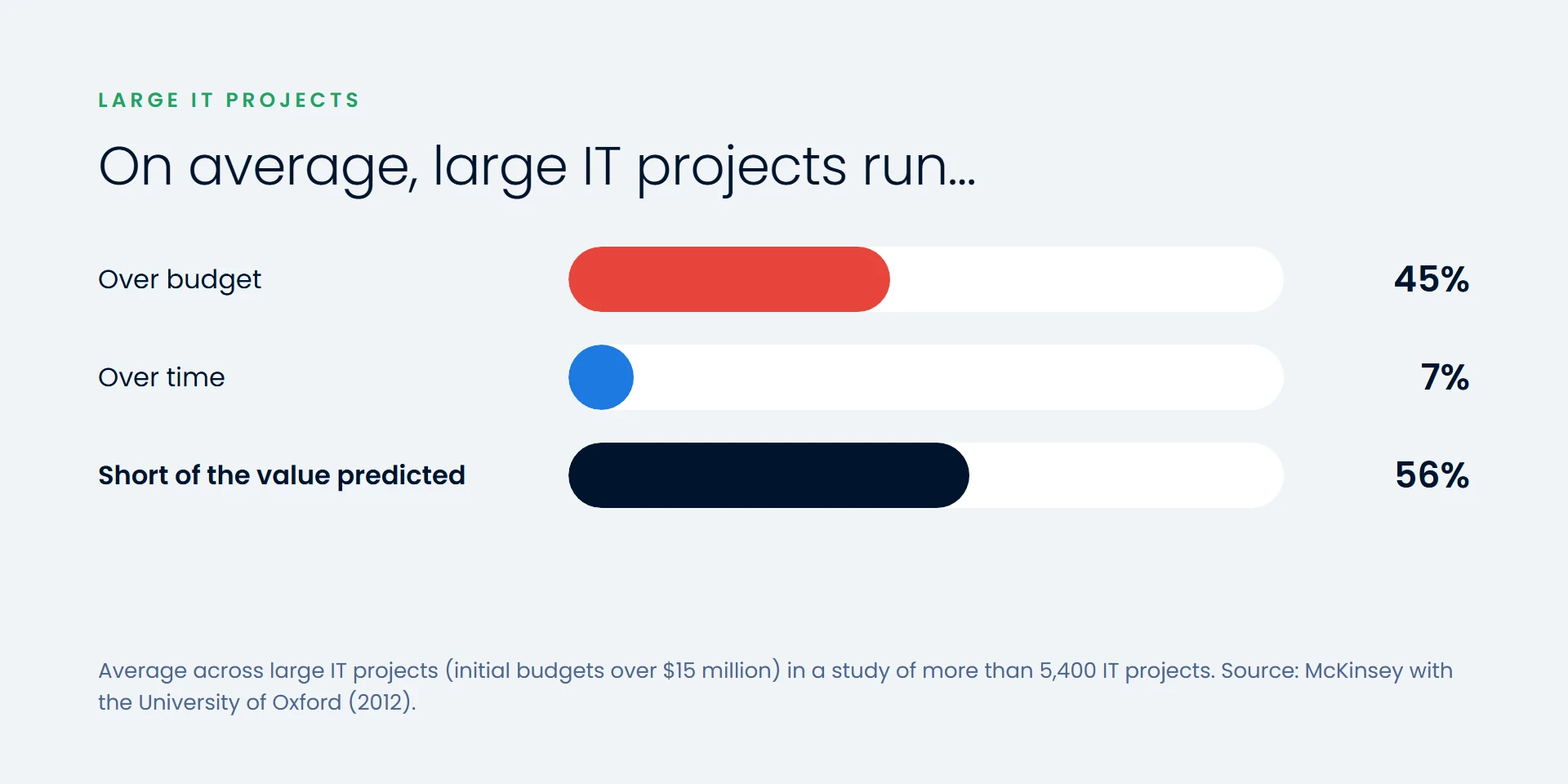
The bigger risk is often not the starting price but the overrun. In a 2012 study with the University of Oxford covering more than 5,400 IT projects, McKinsey found that large projects, with initial budgets over $15 million, ran 45% over budget and 7% over time on average, while delivering 56% less value than predicted. Smaller builds carry the same risk at a smaller scale: when what's being built isn't pinned down, the cost isn't either.
How to get an estimate you can trust
- Define the first release. Agree the smallest version that delivers value, and list what's deliberately left for later.
- Ask what's included. Design, testing, project management, deployment, documentation and support after launch are sometimes priced separately.
- Match the contract to the certainty. A fixed price works when the scope is well defined. A dedicated team suits work whose priorities will change as you learn.
- Ask how changes are handled. On a fixed-price project, each change should be estimated before it's added, so you decide whether it's worth it. On a dedicated team, changes simply move up or down the backlog.
- Budget for running it. Hosting, monitoring, security updates and improvements continue after launch.
A good estimate starts with understanding the project, not with a rate card. Our free technical consultation ends with a plan covering the right tech stack, architecture, timeline and budget for your project, before any work is priced.