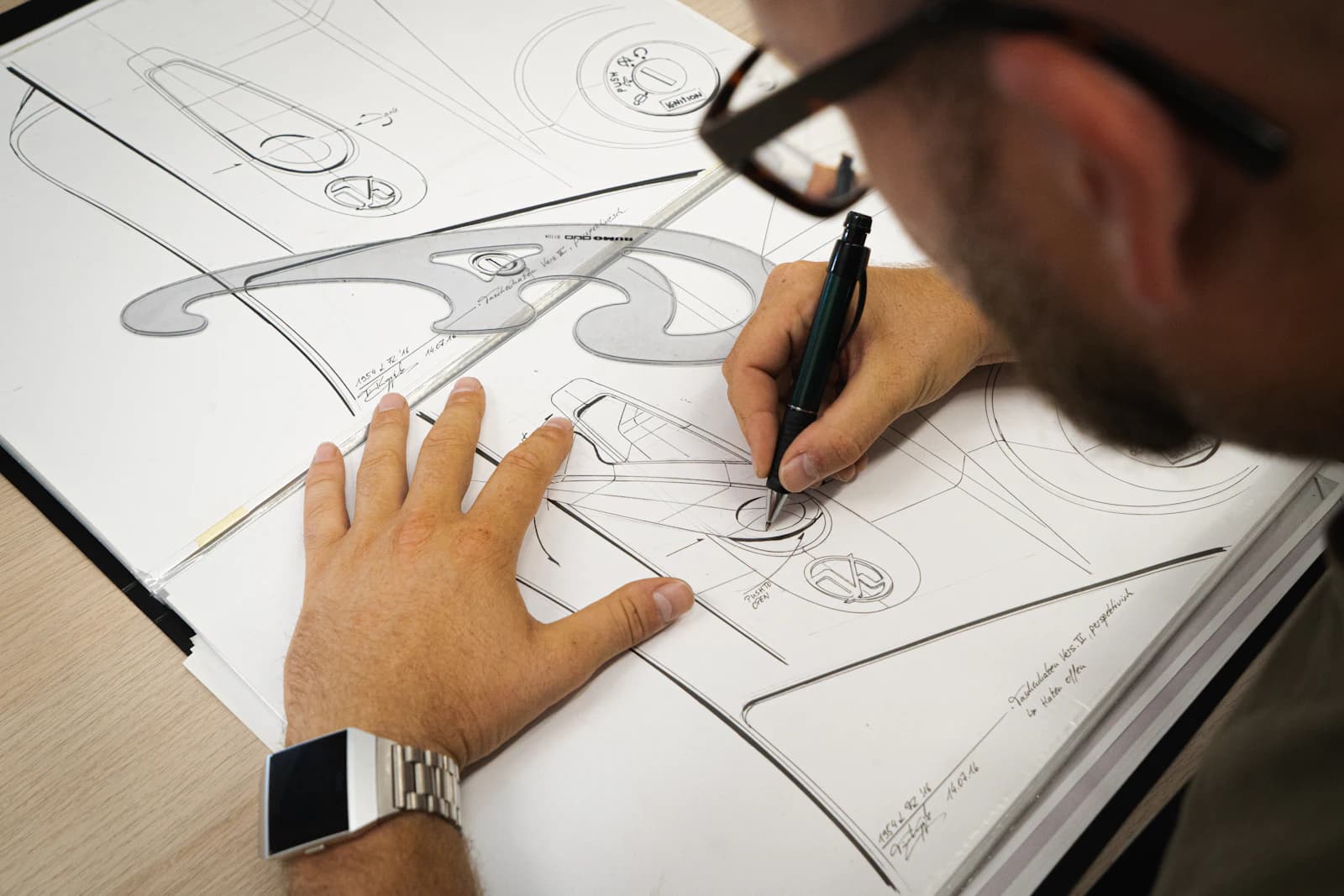
Human-centred design
Services and products designed and tested with the people who use and deliver them.
Home care visit app
Example · user requirements checked in each round of testing with carers
- Record a visit in under two minutesMet
- Works with poor or no signalIterate
- Usable one-handed on a phoneIterate
- Medication record matches the care planMet
- Readable for people with low visionIterate
2 of 5 requirements met. The design goes round again.
What we build
Services designed with your users
We design services and products with the people who use and deliver them: research where the work happens, co-designDesigning with users and staff as active participants, not just test subjects., prototypes tested in every round, and a service design ready to build.
Public and member services
Services used by a wide range of people, including those with access needs.
Staff tools
Internal tools designed with the people who use them all day.
Complex journeys
Healthcare, benefits or claims journeys with many steps and stakeholders.
Inclusive design
Products that work for people of different abilities, languages and devices.
Service redesign
A service reworked end to end, from first contact to outcome, including letters, calls and staff.

How to get started
Three steps to a plan for human-centred design
- 1Tell us what you needUse the project form or book a call. A few sentences about the goal is enough to start.
- 2Free technical consultationWe go through your goals, users, existing systems and constraints with you.
- 3Your planA detailed plan covering the right tech stack, architecture, timeline and budget. Then you decide.
How it works
How we design with your users
Four activities, repeated until the design meets users' needs. Choose one to see what we do.
Understand context
Understand and specify the context of use: who the users are, their goals and tasks, and where and how they work.
- Contextual inquiry and observation
- Interviews with users and staff
- Accessibility needs identified
The prototypes we build
We prototype at the fidelity each question needs, from paper to code. Choose one to see when we use it.
Sketches tested in minutes.
- Sketch
- User tries
- Change
- Repeat
- Fits when
- Early concepts and co-design sessions.
- What it needs
- Pens, paper and willing participants.
- The trade-off
- Very fast and cheap; can't test visual detail or interaction.
Our approach
How the work runs
Understand context
Who uses it, for what goals, in what environment.
Specify requirements
User and organizational requirements, agreed and prioritized.
Produce solutions
Concepts and prototypes, often co-designed with users and staff.
Evaluate
Test with users against the requirements; iterate.
Deliver and learn
Release, measure and keep improving from feedback.
What we'll need from you
Having these ready keeps the work moving.
Users and staff
People to research with and co-design alongside.
A sponsor
Someone who'll act on findings.
Service knowledge
Policies, processes and data about the service today.
Time for iteration
Room in the plan to test and change designs.
Who's on the project
Our team, working with staff representatives from yours.
Your side
Our side
Service designer: Leads research, co-design and prototyping.
Services
Human-centred design services
Contextual research
Interviews, observation and diary studies with users and staff, where the work happens.
Co-design
Workshops with users and staff as participants, not only as test subjects.
Prototyping and testing
Paper to coded prototypes, tested in every round, including with people with access needs.
Service design
Blueprints, requirements and measures of success, ready for delivery teams.
Deliverables
What you receive
Each deliverable is signed off at the gate that closes its phase. Click one to mark it accepted.
In your hands
What the documentation looks like
Every project ends with documents your team can run with. Here is an excerpt of one of them.
Home care visit app
From contextual research with carers
| Aspect | What we found |
|---|---|
| Users | Carers, many part-time, varied digital confidence |
| Tasks | Record visits, medication and notes between homes |
| Environment | In cars and clients' homes, often poor signal |
| Devices | Personal and company phones, one-handed use |
Measuring success
How success is measured
What we report on in human-centred design projects. Which measures apply, and their targets, are agreed with you at the start.
Benefits register
Task success
Users completing key tasks in evaluation.
- Data from
- Usability testing with representative users, task by task
- Measured
- Every evaluation round
The baseline is taken before anything changes; targets are agreed at the first gate.
Built into every project
The six principles every human-centred design project we run follows. Untick one to see what's missing.
Our design principles
Not yet human-centred
- Missing: Users involved throughout design and development
Tick or untick checks to see the result change.
Readiness check
Are you ready for
human-centred design?
Five questions, about a minute. You'll see what to settle first and a sensible starting point.
Entry criteria: Human-centred design
Give each criterion a status. The gate decides from all of them.
- 1.Can we reach the people who use and deliver the service?
- 2.Is the scope of the service clear?
- 3.Will the team act on what users say?
- 4.Is accessibility part of the requirements?
How to start
From first call to production
Start where you are. Each step ends with a decision, so you commit to the next one only when it makes sense.
Engagement roadmap decision gate
- Free technical consultation
- Current-state assessment
- Pilot
- Rollout
- Adopt and improve
Free technical consultation
One or two sessions
Talk through the goal, the users, the systems involved and any deadlines.
Delivered at the gate
- A clear view of scope and priorities
- A recommended next step
- A plan covering stack, architecture, timeline and budget
Estimate the value
What it could be worth to you
Enter your own figures. The formula is shown, and the estimate can go with your enquiry.
Failure demand avoided
Human-centred design · your assumptions, with the formula shown
| Assumption | Value |
|---|---|
| 5,000 | |
| 30% | |
| $8 |
Handling cost avoided
$12,000
a month
Formula: Contacts × share avoidable × cost per contact
Add to my enquiryBuild or buy
When you don't need
a custom build
Part of the free technical consultation: when an existing product covers the need, we recommend it instead of a custom build. These are the options we weigh, alongside the tools you already have.
Option C: tailored
Recommended when
- The service is complex and spans channels
- Users include people with diverse needs
- Staff and processes must change, not just screens
- Evidence is needed for investment decisions
Full scope
Technologies and standards
Chosen for your project
Research and design methods, by the question each answers and when it's used. Choose one to read more.
| Method | Answers | When |
|---|---|---|
| Understand context | How people really work, where and with what | Before designing |
| Understand context | Goals, needs and frustrations, in their words | Early, and when questions arise |
| Understand context | What happens over days or weeks | When the experience spans time |
| Produce solutions | Ideas and priorities from users and staff together | Once the problem is clear |
| Evaluate | Whether people can complete key tasks | Every iteration |
| Evaluate | Whether it works with assistive technologies | Every release |
Contextual inquiry: Watching and talking with people where they do the work, to understand how, where and with what they do it.
Research and testing
- Dovetail
- Lookback
- Maze
- UserTesting
Methods
- Contextual inquiry
- Co-design
- Service blueprinting
- Usability testing
Prototyping
- Figma
- Paper prototypes
- Coded prototypes
Collaboration
- Miro
- FigJam
Next workstream
Business process design
Redesign how the work flows behind the service before anything is automated.
Previous: Customer experienceSteering committee packWorkstream 03
Business process design
Design phase
Redesign how the work flows behind the service before anything is automated.
Questions
Common questions
about human-centred design
How is this different from UX design?
Our UX design work covers digital interfaces. Human-centred design covers the whole service: processes, staff and offline touchpoints as well as screens.
Do users take part?
Yes. We run co-design workshops with users and staff as participants, and test every iteration with them.
How do you include people with disabilities?
We recruit people with disabilities as research and testing participants, design to WCAG 2.2 AA and test with assistive technologies.
How is a transformation engagement priced?
Assessments and pilots are delivered as fixed-price engagements; rollouts are usually delivered by a dedicated team, wave by wave. The free consultation ends with a plan covering scope, timeline and budget.
More in Digital Transformation
How it connects
- FeedsCustomer experienceResearch and co-design shape better journeys.
- Pairs withChange managementStaff involved in design are more likely to adopt the result.
- Pairs withBusiness process designService redesign often means process redesign.
Planning human-centred design work?
Start with a free technical consultation: a detailed plan covering the right tech stack, architecture, timeline and budget for your project.
Start a project